Eid al-Adha 2026: Date, Significance, Prayer & How to Celebrate
Eid al-Adha — the festival of sacrifice — is one of the two Eids in Islam, and the larger of the two by spiritual weight and global participation. It marks the day Prophet Ibrahim (AS) was prepared to sacrifice his son Ismail in obedience to Allah, and the day Allah's mercy replaced the son with a ram. Every year, Muslims around the world reenact that submission through Qurbani — and gather as families and communities to celebrate.
This page covers everything you need for Eid al-Adha 2026: the expected date, the Eid prayer, Sunnah practices for the day, the role of Qurbani, and how to celebrate meaningfully.
When is Eid al-Adha 2026?
Eid al-Adha 2026 is expected on Thursday, 28 May 2026, corresponding to the 10th of Dhul-Hijjah 1447 AH. Final dates depend on the official moon sighting of Dhul-Hijjah by Saudi Arabia's Supreme Court.
The festival lasts up to four days for many Muslim communities — the 10th, 11th, 12th, and 13th of Dhul-Hijjah — though the prayer and the Qurbani sacrifice are concentrated on the first day. The 11th, 12th, and 13th are the Days of Tashreeq, during which Qurbani may still be performed and takbeer is recited after every obligatory prayer.
| Day | Hijri | Expected Gregorian | Notes |
|---|---|---|---|
| Eid Day 1 | 10 Dhul-Hijjah | ~28 May 2026 | Eid prayer, Qurbani, family gathering |
| Day 2 | 11 Dhul-Hijjah | ~29 May 2026 | Qurbani still permitted, takbeer continues |
| Day 3 | 12 Dhul-Hijjah | ~30 May 2026 | Qurbani still permitted, takbeer continues |
| Day 4 | 13 Dhul-Hijjah | ~31 May 2026 | Qurbani permitted by some scholars; takbeer ends |
The story behind Eid al-Adha
Eid al-Adha commemorates the most powerful test of obedience in the Abrahamic tradition. Prophet Ibrahim (peace be upon him) received a command from Allah, conveyed in a dream, to sacrifice his beloved son Ismail (peace be upon him).
Ibrahim told Ismail. The son's response is preserved in the Quran:
"O my father, do as you are commanded. You will find me, if Allah wills, of the steadfast." — Surah As-Saffat 37:102
On the way to fulfill the command, Shaytan appeared three times to whisper doubt. Ibrahim threw stones at him each time — the origin of the Hajj ritual of stoning the Jamarat.
When Ibrahim laid Ismail down and raised the knife, Allah called out:
"O Ibrahim, you have fulfilled the vision." — Surah As-Saffat 37:104–105
Allah replaced Ismail with a ram. The act of sacrifice was honored; the son was spared. From that moment, the annual sacrifice of an animal — Qurbani — became an act of worship in remembrance of Ibrahim's submission and Allah's mercy.
For the full story behind the rituals of Hajj, see the story of Hajj.
The Eid al-Adha prayer
The Eid prayer is a Sunnah Mu'akkadah (highly emphasized Sunnah) — performed in congregation, typically in an open space (musalla) or large mosque, shortly after sunrise on the morning of the 10th of Dhul-Hijjah.
How the Eid prayer is performed
- Two rakats — the standard structure of the Eid prayer.
- Six extra takbeers — three in the first rakat (after the opening takbeer, before reciting Al-Fatihah) and three in the second rakat (before going into ruku'). Some schools differ slightly in number and placement.
- No adhan or iqamah is called for the Eid prayer.
- A khutbah follows the prayer (after, not before — opposite of Friday).
- Sunnah practices before the prayer:
- Eat sparingly or not at all before the prayer (the actual Eid meal is after, with the Qurbani meat).
- Wear your best clothes.
- Take a ghusl (full ritual bath).
- Walk to the prayer ground if possible.
- Recite takbeer aloud on the way: Allahu Akbar, Allahu Akbar, La ilaha illa Allah...
Eid prayer time
Most communities hold the Eid prayer roughly 15 to 30 minutes after sunrise. Check your local mosque's announcement for the exact time.
Qurbani — the central act of Eid al-Adha
The defining act of Eid al-Adha is Qurbani — the sacrifice of an eligible animal in remembrance of Ibrahim's submission. Qurbani is wajib (obligatory) upon every adult Muslim who:
- has reached the nisab (the same financial threshold as Zakat),
- is of sound mind,
- and is not a traveler.
Eligible animals
- Sheep or goat — counts as one Qurbani share, must be at least 1 year old (or appearing so).
- Cow or bull — counts as seven Qurbani shares, must be at least 2 years old.
- Camel — counts as seven Qurbani shares, must be at least 5 years old.
Distribution of meat
The Sunnah is to divide the meat into three portions:
- One third for your family.
- One third for relatives and neighbors.
- One third for the poor.
The third for the poor is what gives Qurbani its spiritual force. The Prophet ﷺ instructed that no eligible Qurbani should be eaten only by the wealthy — the meat must reach those who would otherwise rarely eat it.
Where to give Qurbani
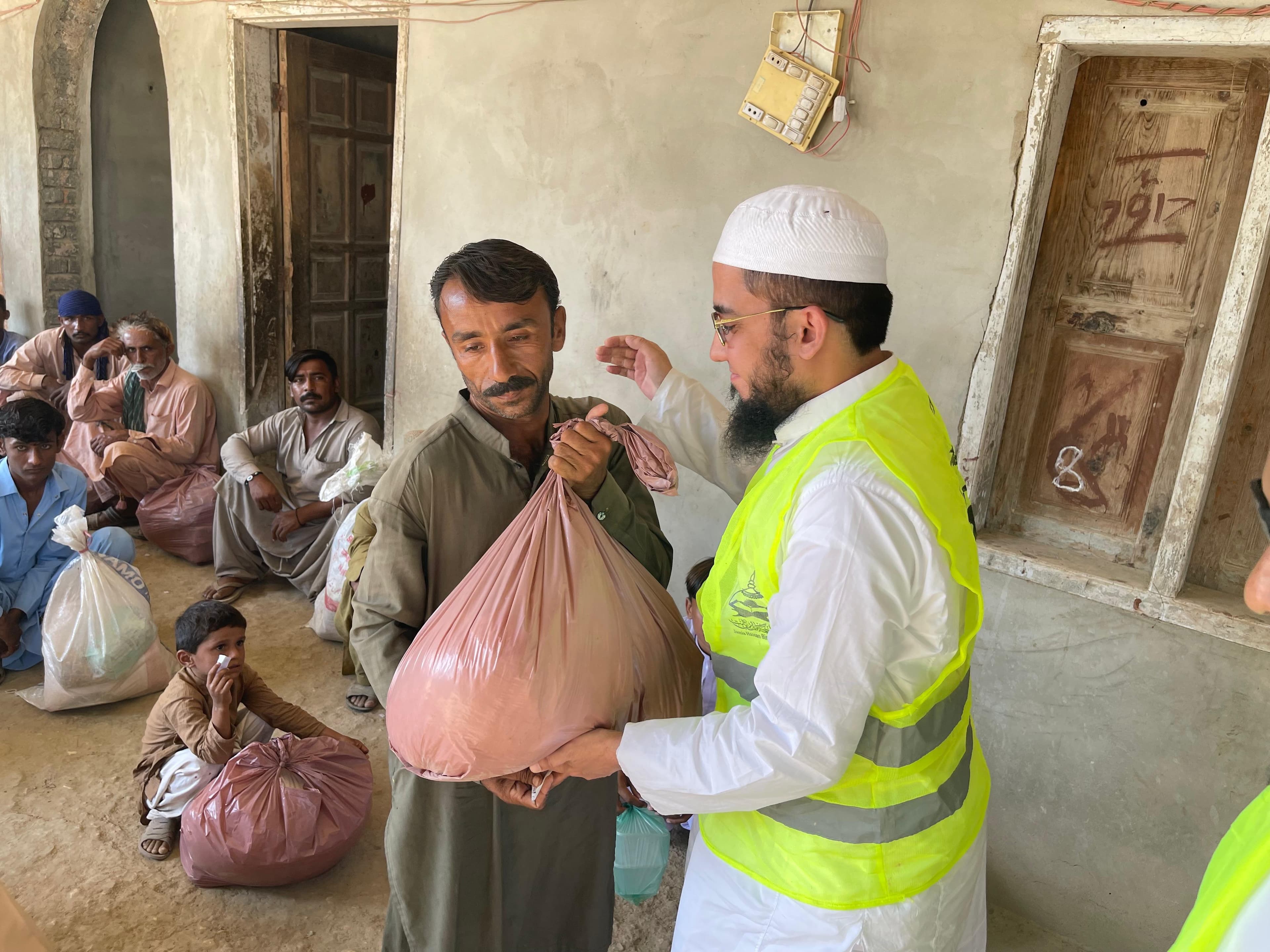
Many Muslims arrange Qurbani in their own city; many give it abroad to families in greater need. Both are valid. Through HBSMWA, your Qurbani feeds flood-affected families in Pakistan and Muslim families in Palestine.
Give your Qurbani 2026 with HBSMWA — every share feeds a family that would otherwise eat no meat for the entire year.
Sunnah practices for Eid al-Adha day
The Prophet ﷺ taught a set of Sunnah practices that frame the day:
- Wake early.
- Take a ghusl (full ritual bath).
- Wear your best clothes — clean, ironed, your finest.
- Apply attar (perfume).
- Recite takbeer aloud as you walk to the Eid prayer.
- Walk to the prayer ground by one route, return by another (Sunnah of the Prophet ﷺ).
- Pray Eid in congregation.
- Greet others with "Taqabbal Allahu minna wa minkum" — "May Allah accept (it) from us and from you."
- Perform Qurbani (or arrange for it).
- Eat from your Qurbani (the Prophet ﷺ would eat from his sacrifice's liver after the prayer).
- Visit family.
- Distribute meat to neighbors and the poor.
Eid al-Adha for those alone or far from family
For Muslims who are traveling, working far from home, students abroad, or simply far from family — Eid al-Adha can feel quiet. Some practical advice:
- Find your local Muslim community. Eid prayers are held in cities you might not expect — check ICNA, ISNA, or your nearest mosque listings.
- Host or attend a small gathering. Even a single shared meal with one or two other Muslims keeps the day alive.
- Send Eid greetings — call family, even if briefly.
- Give Qurbani even if you cannot share the meat in person. Arranging Qurbani through a charitable organization is a long-standing practice.
How to greet someone on Eid al-Adha
Common greetings:
- Eid Mubarak — "Blessed Eid." (Most common.)
- Eid Sa'eed — "Happy Eid."
- Taqabbal Allahu minna wa minkum — "May Allah accept (it) from us and from you." (Sunnah of the Companions.)
- Hajj Mubarak — to/about pilgrims; can also be used during the Eid season. See our Hajj Mubarak guide.
A reminder: Eid al-Adha is a global act of mercy
When two billion Muslims simultaneously sacrifice an animal and distribute the meat, the result is one of the largest single acts of food redistribution on the planet. Communities that rarely eat meat suddenly have plenty. Children remember the day. Elders are honored.
This is the genius of Qurbani: it turns a private act of submission into a worldwide feast for the poor.
Give your Qurbani 2026 with HBSMWA — your sacrifice feeds families in flood-affected Pakistan and Palestine. The same Sunnah of Ibrahim, lived in our generation.
Read next: The Best 10 Days of Dhul Hijjah → · The Blessed Month of Dhul-Hijjah → · The Story of Hajj → · Hajj 2026 Dates →